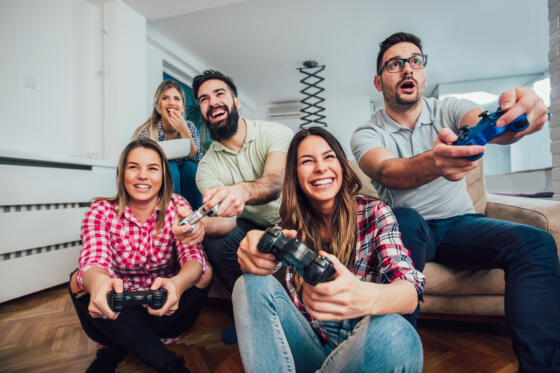
What gamers are better at
Professor Froböse, you’re intensively dealing with the subject of gaming – that seems rather unusual for a sports scientist. How did that happen?
In fact, the subject came to me, not vice versa. Students carried it into my office. Gaming is part of their life reality – so I had to deal with it. That led to initial academic work, followed by larger projects. What intrigued me was to find out what’s really happening there – physically, mentally, socially.
The expert

Professor Ingo Froböse is one of Germany’s leading health experts. He is a university professor for prevention and rehabilitation in sports at the German Sport University Cologne where until 2023 he led the Institute for Movement Therapy. As the author of best-selling books about health, nutrition, and sports, Ingo Froböse is known to the general public. In addition, he’s a sought-after media expert and with his “Formel Froböse” channel on YouTube reaches nearly 90,000 subscribers. Froböse is an acknowledged supporter of Esports.
And what is happening there?
A lot more than many people suspect. Gaming is a practice of capabilities that we know from the world of work: concentration, responsiveness, strong decision-making skills under time pressure. Especially in competitive games, teamwork is an additional aspect – coordination, confidence, distribution of roles. Those are classic skills that are desirable in business as well.
"It’s a high-density training room. Decisions must be made quickly and information processed in parallel. That’s comparable to many professional situations – for instance, in controlling complex technical systems or in project management."
Prof. Dr. Ingo Froböse
So gaming is a kind of training for professional life?
In a way it is. It’s a high-density training room. Decisions must be made quickly and information processed in parallel. That’s comparable to many professional situations – for instance, in controlling complex technical systems or in project management. It becomes especially intriguing when gaming is understood as simulation.
Simulation in the sense of virtual reality and industrial applications?
Exactly. The transitions are smooth. Whether flight simulators, surgical training, or industrial maintenance via VR – the principle is identical: I practice processes in a controlled environment. Gamers often possess a high level of basic skills for that. They’re used to orienting themselves in digital rooms, to respond fast, and to control complex processes.
Even so, gaming still has a somewhat negative image.
That’s primarily a generational question. Many of today’s decision makers did not grow up with gaming. For them, it’s unfamiliar but that’s currently changing. Gaming is increasingly being accepted as a form of culture – similar to the way movies or music used to be. At the same time, critical aspects should not be ignored. Content such as violence or role models are justifiably subjects of public debate. However, from an academic perspective, the individual game is less crucial than the way it’s being dealt with – in other words, context, duration, and reflection. It’s problematic especially when consumption takes place in uncontrolled or socially isolated ways.
So you don’t advocate unlimited gaming.
Exactly. It’s the dose that counts. We know from studies that concentration drops after about 20 to 30 minutes of intensive stress. Gamers that play for hours on end lose performance capacity – and risk encountering health issues. That’s why we work with clear structures: gaming phases, breaks, physical compensation.
So, you deliberately combine gaming with physical exercise?
Yes, that’s central. We meet people at the console – and lead them back into physical exercise. The objective is not to do less gaming but better gaming. People who are physically fit are mentally fitter as well. That’s true in sports just like in Esports.
What does that kind of “better gaming” specifically look like?
We work with programs that combine gaming and physical activity. Part of the day is devoted to gaming and another one to physical exercise, plus aspects like regeneration, nutrition, concentration techniques. We basically treat E-gamers like competitive athletes.
The Benefits of Gaming at Work
And does that work?
It really does, especially because gamers understand that if they want to get better they must do more than just engage in gaming. That changes the way people deal with the medium.
Looking ahead: How is gaming going to develop technologically?
I see a clear trend toward more physical integration. Virtual reality, augmented reality, motion-controlled systems – all that will move gaming into the real world more intensively. You could say: gaming is going to become more physical.
So, moving away from pure sitting?
Exactly. The most exciting developments are those that combine the digital and the physical activity. That not only is healthier but also more interesting technologically. In that way, gaming will become an interface between the digital and the real world.
And what will that mean for companies?
Big opportunities. Gaming skills are becoming more relevant – especially in the previously mentioned areas like simulation, control of complex systems, or teamwork in digital settings. At the same time, the gaming culture can help develop new forms of working together.
Your conclusion?
Gaming is not a problem that needs to be solved. It’s a potential that should be understood. If we use it correctly, it can promote skills, improve health, and even drive innovation.
How gaming drives innovations from AI to autonomous vehicles
As the whitepaper titled “Games & Innovation: The Role of Games in Societal Innovation” by the MIT Game Lab shows, gaming was a key driver of technological development for decades – often far beyond the pure entertainment sector. Games served as experimental fields for testing new technologies under realistic conditions and accelerating their further development.
Even the early home computer revolution was decisively shaped by games: Systems like Apple II and Commodore Amiga systematically emphasized enhanced graphics and sound capabilities. Subsequently, these innovations formed the foundations for applications in design, media production, and science.
The development of modern graphics cards is directly the result of requirements of 3D games – technologies that today are essential for AI and machine learning. This pathway reaches all the way into the present: Nvidia in the United States, originally specialized in gaming CPUs, generated sales of around 216 billion USD in the 2025 financial year and today is a key driver of the AI era. In addition, with platforms such as DRIVE Hyperion, Nvidia – Schaeffler has entered into a technology cooperation with the industry giant – has developed the basis for autonomous driving up to Level 4 and is evolving into the infrastructural backbone of the automotive industry.
In the 1990s, multiplayer games advanced the development of voice communication via the internet. In-game voice chat became the standard early on and provided the foundation for today’s VoIP services such as Skype or Zoom.
In parallel, game engines established new standards for simulation, visualization, and interaction – used today in architecture, vehicle development, urban planning, and cultural conservation.
The conclusion of the whitepaper is that gaming is not a sideshow but a key innovation engine that has shaped hardware, software, and digital ways of thinking – and will continue to do so.