Between weightlessness and reality
When the Airbus A310 ZERO‑G took off from Bordeaux on May 19, 2026, the researchers on board embarked on what seemed like an unspectacular journey – but was of great scientific significance: weightlessness. Three flight days, 93 parabolas, and around 35 minutes of microgravity are available during the current parabolic flight campaign conducted by the German Aerospace Center (DLR). Not much time, but enough to gain valuable insights across many fields of research.
Weightlessness on demand
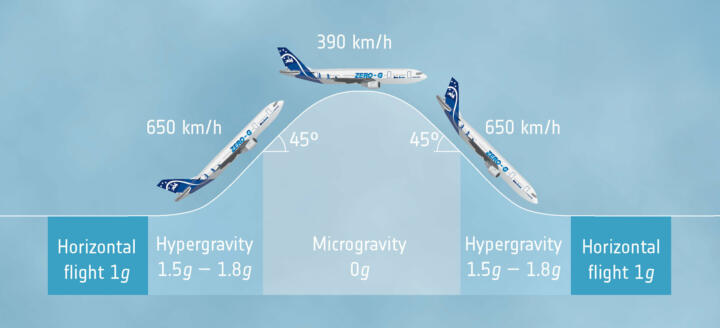
During parabolic flights, the aircraft follows a wave-like trajectory in the sky. From level flight, the jet repeatedly climbs steeply upward, briefly reaching nearly twice Earth’s gravitational acceleration. The specially trained pilots then significantly reduce thrust. Ideally, the flight path follows a perfect ballistic parabola. During this phase, gravity and inertia cancel each other out inside the cabin – resulting in about 22 seconds of weightlessness. The aircraft is then pulled out of the maneuver, again with increased g-forces, before the next cycle begins. A roller-coaster in the sky. It’s easy to see why NASA calls its parabolic flight aircraft, the Boeing KC-135, the “Vomit Comet.”
For researchers, parabolic flight experiments are demanding work at the limit – not only because of the physical strain. Their experiments must also be designed to deliver meaningful results within just a few seconds of complete weightlessness. Despite these challenges, parabolic flights are considered unique laboratories: they allow scientists to simulate conditions that normally exist only in space, without the enormous costs and long preparation times of a space mission.
The laboratory in the sky
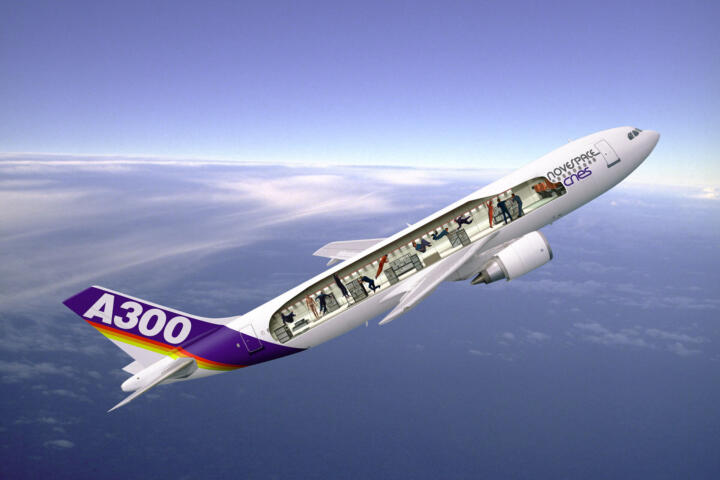
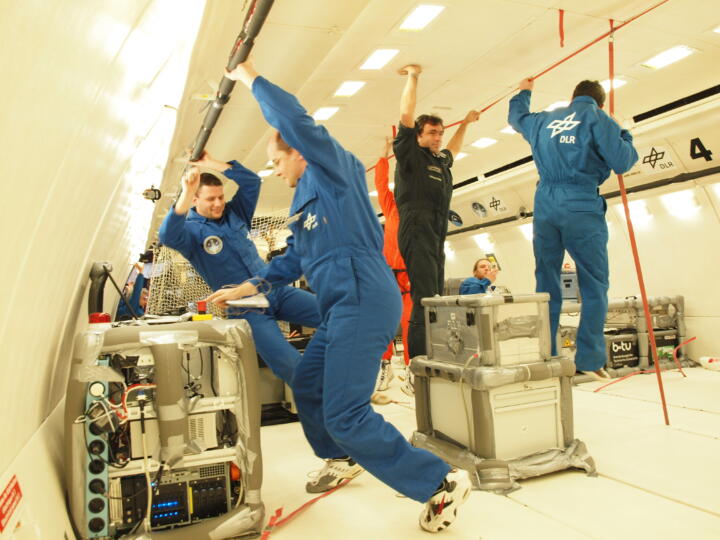
The interior of the ZERO‑G Airbus used by DLR has been completely redesigned. Instead of seats, there is a roughly 20-meter-long padded experimental area with power supply, data systems, and safety equipment. Up to 40 scientists work simultaneously on topics such as materials research, biology, and medicine. A positive side effect of this diverse scientific mix: parabolic flights often become a source of new interdisciplinary approaches.
Building on the Moon – with dust and laser
One experiment in the current DLR campaign illustrates how tangible the applications derived from this research have already become. The Federal Institute for Materials Research and Testing is investigating whether lunar rock – so-called regolith – can be used directly on the Moon as construction material.
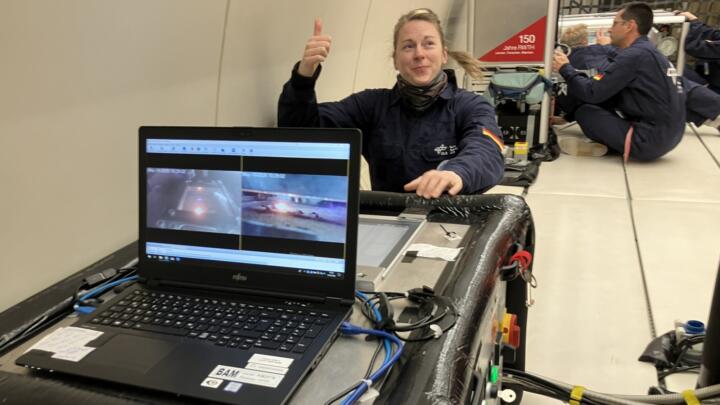
The idea is as simple as it is revolutionary: instead of transporting tons of building materials from Earth to the Moon, future missions could use resources already available on site. A specially developed system melts regolith powder using a laser under vacuum conditions. Similar to a 3D printer, this process creates solid structures. However, the Moon is not an easy working environment. There is no atmosphere, gravity is only about one-sixth of Earth’s, and fine particles behave differently than on our planet. This is where parabolic flights come in: they allow these conditions to be partially simulated. How does molten material behave without an atmosphere? How do altered forces affect structure? And could escaping dust contaminate sensitive laser optics? Answers to these questions are crucial – not only for future lunar roads or habitats, but also for handling materials in extreme environments more generally.
€7,950
for zero gravity: that’s the price of a ticket for a parabolic flight aboard the ZERO‑G Airbus. Anyone aged 18 or older can participate, provided they meet the certified medical requirements. The oldest participant was over 90 years old.
When the brains starts to falter
It’s not only machines that must adapt to weightlessness – humans do too. A second experiment in the current DLR campaign, conducted by scientists at the University of Magdeburg, investigates how microgravity affects concentration and reaction times. Even short periods without gravity can disrupt the interaction between the sense of balance and visual perception. The brain receives conflicting signals, which can lead to disorientation, slower reactions, and increased error rates – a critical factor in space missions. Weak electrical impulses may help stabilize performance under such unusual conditions.
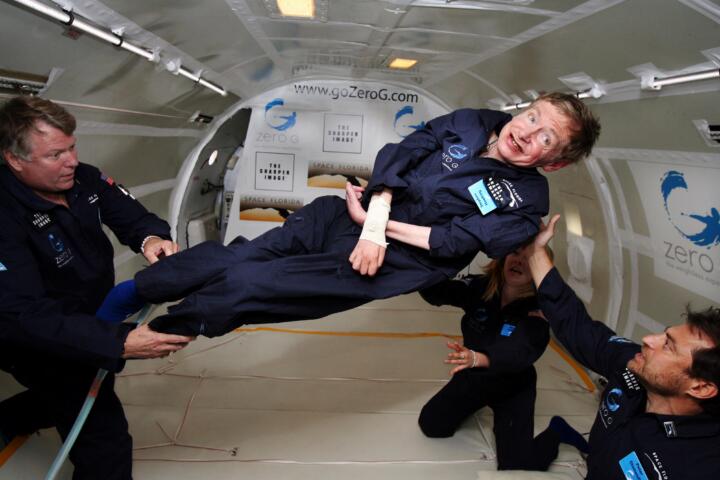
During the most recent parabolic flight, test subjects were either actually stimulated or given a placebo treatment. Their cognitive performance was measured before, during, and after the parabolas. The analysis is still ongoing, but if a positive effect can be demonstrated, wearable devices could support astronauts in the future – a development with potential applications far beyond space travel, for example in medicine or high-stress professions.
22 seconds that matter
Despite their relatively short experiment times, parabolic flights offer several decisive advantages in addition to cost. Experiments can be prepared within just a few months and repeated multiple times – a key difference compared to the space station, where access often has to be planned years in advance. Another invaluable factor is direct control: unlike in space, researchers conduct their experiments themselves, adjust parameters on the fly, and respond immediately to unexpected results. This proximity turns parabolic flights into a kind of “workshop of space exploration” – a place where ideas can be quickly tested, discarded, or refined.
Increasingly, research into reduced gravity is also coming into focus. By slightly modifying flight maneuvers, conditions corresponding to those on the Moon (0.16 g) or Mars (0.38 g) can be simulated. These so-called partial‑g parabolas enable targeted investigation of scenarios relevant to future missions – from walking on alien surfaces to the operation of machinery on other planets. Many of these dynamic conditions cannot be reproduced either in ground-based laboratories or aboard a space station – only in parabolic flights. This is another reason why they are so valuable for science.